
Air Duct Cleaning: Repair or Replace? How Taylorsville Homeowners Decide
Most homeowners never get a straight answer to this question because they only hear from whoever they called first. A cleaning company wants to clean. An HVAC installer wants to sell equipment. Neither has much incentive to walk you through the middle ground. Here’s the honest version: repair-or-replace is a decision you make from what an inspection finds, not from what the first technician in your utility room suggests. This guide walks through that decision the way we actually assess it in homes around Taylorsville.
If you’d rather have a trained eye look at your system than sort through it yourself, call (833) 468-5997. We answer 24/7, and estimates are free.
Why Inspection Comes Before Any Recommendation
No repair-or-replace call is valid without two things: a visual inspection of your accessible ductwork and a duct leakage test. Skip either and you’re guessing. We’ve watched this go wrong in both directions – a cleaner who sold a full cleaning on ductwork that was already failing at the seams, and an HVAC company that quoted a new system without ever measuring how much air the existing ducts were losing.
The visual inspection is exactly what it sounds like. A technician opens access points and looks inside the runs, branches, and plenum with a camera or direct line of sight. What they’re checking for: disconnected joints, crushed or torn flex, failed tape and mastic at the seams, internal debris type, and whether any duct runs through unconditioned space without proper insulation.
The leakage test is where the numbers come from. Two tools do this work. A blower door pressurizes the whole house and measures total air leakage, which tells you how leaky the building envelope is as a system. A duct blaster connects directly to the duct system and pressurizes it in isolation, measuring how much of your conditioned air is escaping through duct seams and joints before it ever reaches a room. The duct blaster is the more useful test for this decision because it isolates the ductwork. In our experience, the test matters as much as the inspection in Taylorsville’s mixed housing stock, where 1970s-era construction and newer builds can sit on the same block with very different duct assemblies.
When Cleaning Is the Right Answer
Cleaning is appropriate when the ducts are structurally intact, properly sealed, and contaminated only with accumulated particulate. “Structurally intact” is a specific condition, not a feeling. Here’s what it means in observable terms:
- Every visible joint and seam is still connected – no gaps where one section should meet the next
- Flex duct runs are full-diameter and smooth, not crushed, kinked, or pinched between framing members
- Tape and mastic at the seams are still bonded, not peeling, cracking, or pulling away
- No sections sag, sagging ducts are collapsed ducts
- Debris inside is dust, pet hair, drywall dust, or general particulate – not biological growth spread across a wet surface
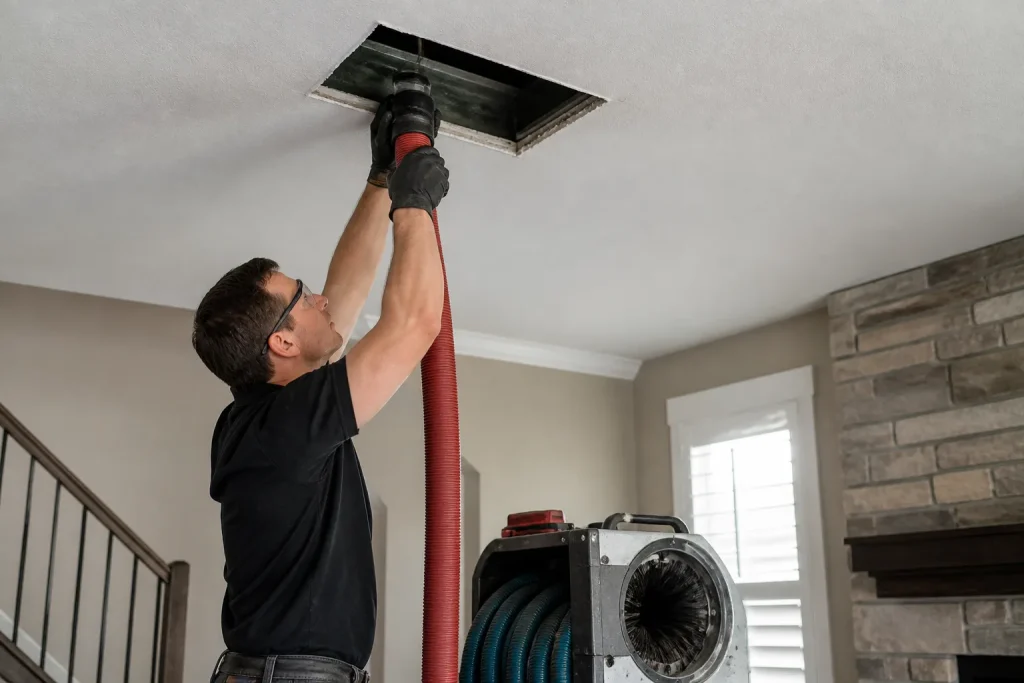
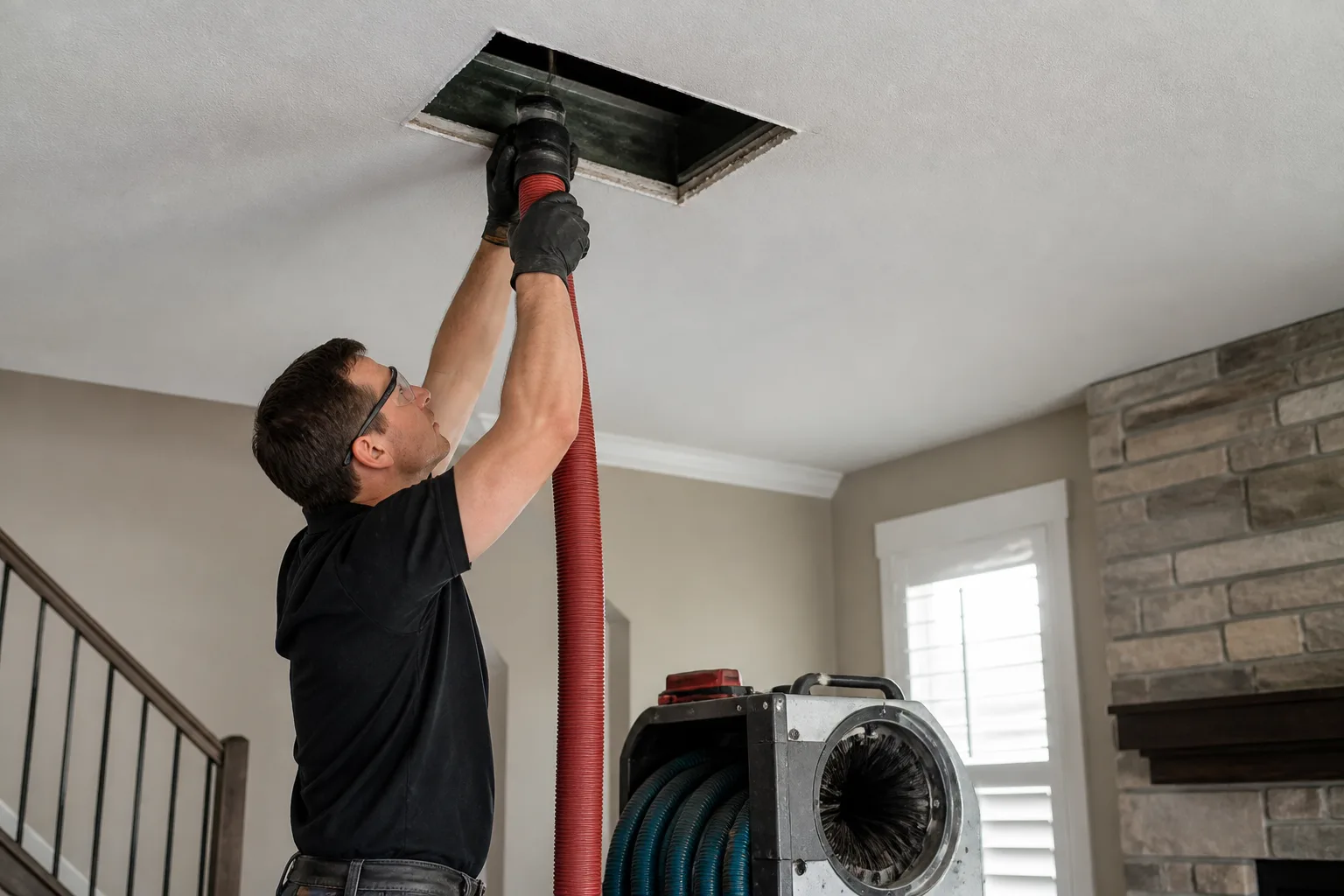
If all five conditions hold, the contamination is a cleaning problem, not a mechanical one. This is the case in plenty of Taylorsville homes, especially those that have never had the ducts serviced and show nothing but dust buildup. A professional rotary-brush system like Rotobrush – the platform our technicians use – is built for exactly this: dislodging compacted debris from the duct walls, not just hosing down the interior. Paired with Nikro HEPA-rated vacuum equipment capturing fine particulate at the source, cleaning restores airflow and air quality in these systems without a single repair.
That said, cleaning a duct system with mechanical failures doesn’t fix the failures and can make them worse. Agitation pushes air and debris through every seam. If a joint is already separated, it’ll blow dust into your attic or crawl space instead of into the vacuum.
When Repair Is the Right Answer
Repair is the answer when the ducts have mechanical failures – the kind of damage cleaning can’t correct. Disconnected joints, torn flex duct, failed mastic or foil tape, and collapsed sections are the four we run into most, and they’re not rare in Taylorsville’s 1970s through 1990s era homes. That period of construction used a lot of flex duct and a lot of standard foil tape, neither of which ages well over several decades in an attic or crawl space.
Why these failures matter beyond simple airflow: every disconnected joint is a hole in your conditioned envelope. In summer, that gap pulls hot attic air into your supply ducts. In winter, it pulls cold air in the same way. Your furnace or AC works harder to condition air that then leaks out before reaching the room. That’s the hidden cost of an unaddressed duct failure, and it’s why a duct leakage test is the diagnostic that tells you whether the seams are actually holding.
Repair means reconnecting what’s failed, resealing every joint with fresh mastic or foil tape rated for the temperature, and replacing any duct section that’s crushed beyond recovery. Sealing is what makes the repair stick. A joint that’s been reconnected but not sealed is a temporary fix, and a technician who reconnects a joint without sealing it hasn’t finished the job.
If your home has this kind of damage, repair plus a full cleaning is usually the right combination. You fix the failures first, then clean the system so the new seams don’t get fouled by old debris. We handle air duct cleaning and duct repair as one integrated visit for exactly that reason.
When Replacement Is the Right Answer
Replacement is the answer when the cost to repair properly exceeds the cost to build new – and that happens under three conditions in Taylorsville homes:
- Asbestos-containing duct board. Homes built before the 1980s sometimes have duct board containing asbestos. Disturbing it requires certified abatement, and the abatement alone can cost more than rebuilding the duct run in modern materials.
- Severely undersized trunk lines. A trunk line that’s too small for the system creates chronic static pressure problems – your blower works against back pressure, air distribution is uneven, and no amount of cleaning or sealing fixes the sizing. Resizing means rebuilding the trunk.
- Ductwork routed through unconditioned attic space with no insulation. An uninsulated run in a Taylorsville attic loses or gains heat along its entire length, and the correct fix often means re-routing the run inside the thermal envelope, which is essentially new ductwork.
The common thread in all three is that the “repair” isn’t a repair at all – it’s a rebuild in place. If that’s where you land, it’s worth getting a quote from a licensed HVAC contractor alongside a duct-cleaning quote so you’re comparing actual scope, not just the totals.
Related reading if your issue is in the HVAC cabinet itself: our HVAC cleaning page covers what a system cleaning involves beyond the ducts. And if you’re seeing lint buildup on the outside vent, see dryer vent cleaning – that’s a separate system with its own fire-risk timeline.
The Cost Comparison Framework
Here’s how to think about the three options financially. The numbers you get from any company should break out cleaning and repair separately. If they’re bundled into one number, ask for the breakdown. That’s not being difficult – a company that won’t show its line-item scope is one you should question before signing.
- Full duct cleaning: Cleaning of all accessible runs plus the air handler. The appropriate scope for a structurally sound, well-sealed system.
- Targeted repair plus cleaning: Reconnect and reseal failed joints and replace damaged flex runs, then clean. The appropriate scope for a system with mechanical failures that’s otherwise worth keeping.
- Partial replacement: Rebuild one trunk or branch line where the damage is concentrated, then clean the rest. The appropriate scope for a system where most of the ductwork is sound but one section is beyond repair.
That third option is the one homeowners miss. A phased approach – clean what works, repair what’s failed, replace only the portion that needs replacing – is often the correct answer, and any company that doesn’t offer it deserves scrutiny. If the only quotes you get are full replacement or full cleaning, the recommendations are being shaped by what the company can sell, not what your system needs.
One more thing to know: any final number should come in writing before work begins. Pricing is per job, set by the written estimate, and that estimate is free.
When to Call a Pro (and When You Can Wait)
Some symptoms are worth a professional look right away. Others can wait for a scheduled visit. The line between them isn’t about urgency – it’s about whether the symptom is a sign of a mechanical failure you can’t fix by cleaning.
Call a pro now if you notice:
- Musty or stale smells coming from supply vents, especially if they persist after the system has run a while
- Visible debris or visible air flow at duct seams in the attic or mechanical room
- Uneven airflow between rooms that has gotten worse over time
- Rising energy bills with no other explanation
- Allergy or respiratory symptoms that flare when the system runs
Once you’ve called, the technician’s first job is inspection – not selling. We answer 24/7 and dispatch from 7am to 7pm, Sunday through Friday. If your call comes in outside that window, it’s booked into the next opening. And it’s worth saying plainly: you shouldn’t sign anything until you’ve seen the inspection findings. See what’s in your ducts before deciding what to do about it. Any recommendation without documented findings is a sales pitch.
The Bottom Line
If your ducts are intact, sealed, and contaminated only with particulate, clean them. If joints are disconnected, flex is torn, or the tape and mastic have failed, repair them – and then clean. If the duct board contains asbestos, the trunk is undersized, or the runs are routed through an unconditioned attic without insulation, replacement is the honest answer. Between those three poles there’s a lot of room for a phased approach, and the right company will offer it.
One light note from the field: the utility room always tells the truth, even when the contractor standing in it doesn’t. Your ducts are either connected or they aren’t. A moisture meter either reads wet or it doesn’t. That’s why the inspection matters more than the opinion.
If you’re in Taylorsville and need help sorting through what your ducts actually need, Taylorsville Air Duct Cleaning Pros offers free estimates. Call (833) 468-5997. We answer 24/7, fast dispatch from 7am to 7pm, Sunday through Friday. Our technicians have up to 12 years of experience, we use Rotobrush and Nikro equipment on every job, and we’ll walk you through what we find before you decide anything. For a full picture of what we offer, see Taylorsville Air Duct Cleaning Pros.
Frequently Asked Questions
A duct leakage test plus a visual inspection of accessible ductwork tells you. The leakage test measures how much conditioned air is escaping through seams and joints. The visual inspection checks whether the ductwork is structurally intact. If the seams are holding and the damage is just dust and debris, it’s cleaning. If joints are disconnected or flex is torn, it’s repair. Call (833) 468-5997 for a free estimate – we’ll show you the findings before making a recommendation.
Yes – cleaning a duct system with mechanical failures is a waste, because the failures stay in place and the agitation can push debris through the gaps. It’s also pointless if the contamination is minimal and the system is otherwise sound. A professional inspection should tell you honestly whether cleaning is the right call for your home, and a good technician will tell you when it isn’t. Call (833) 468-5997 to schedule one.
Because the two companies likely have different incentives and may not have run the same diagnostics. A cleaning company sells cleaning. An HVAC installer sells equipment. Neither has a strong reason to recommend the phased middle path unless they offer both repair and cleaning as one integrated service. Ask each for the inspection findings and the leakage test readings in writing. If the recommendation doesn’t match the data, ask why. Call (833) 468-5997 for a quote that breaks out the scope line by line.
A visual inspection is worth doing before any cleaning or repair decision, and a leakage test is worth doing any time you notice uneven airflow, rising energy costs, or musty smells that persist. There’s no fixed schedule that fits every Taylorsville home – a 1970s build with original flex duct has different needs from a newer house with modern sealed ductwork. The answer is driven by what the system shows, not by a calendar. Call (833) 468-5997 to schedule an inspection.
Written by the team at Taylorsville Air Duct Cleaning Pros.
Need Air Duct Cleaning Help?
Call Taylorsville Air Duct Cleaning Pros - the local pro we connect you with is licensed and insured, with free written estimates in Taylorsville.
(833) 468-5997