
Emergency Air Duct Cleaning Near Me: What Taylorsville Homeowners Should Do First
If you just found mold, rodent debris, or smoke damage in your ductwork, running a cleaning machine through it right now is probably the worst thing you can do. A spinning brush on loose contamination does one thing well: it throws that contamination into every room of your house through the supply vents. What most people call an emergency duct problem in Taylorsville isn’t a cleaning emergency at all. It’s a containment emergency, and the first hour is about stopping the spread, not scrubbing the duct.
If you’d rather not sort through this alone, call (833) 468-5997. We answer 24/7 and can walk you through the shutdown steps before anyone gets in a vehicle.
Why “Emergency Duct Cleaning” Is Usually a Containment Problem First
A duct system under normal use is a closed loop with a blower pushing air through it. When contamination enters that loop (smoke, animal waste, mold spores), the blower keeps running until someone stops it. Cleaning before you stop the blower just moves the problem around faster.
In our experience, the homeowners who end up with the biggest mess are the ones who called a cleaning crew first and asked questions second. A rushed cleaning on an active contamination source can:
- Push loose debris past the register boots into living space
- Spread mold spores from one affected branch to the rest of the system
- Stir up rodent droppings before anyone has dealt with the source or assessed the risk
- Leave the actual cause (a breach, a leak, an unsealed return) untouched, so it returns within a season
The right first move is always assessment and containment. Once the source is identified, the system is shut down, and the work area is protected, a professional cleaning can actually solve something. Cleaning first is how a manageable problem becomes a whole-house one.
Which Situations Are the Real Duct Emergencies in Taylorsville?
Three situations genuinely qualify as urgent contaminant events inside a duct system: post-fire smoke contamination, an active rodent infestation, and confirmed mold growth. Each one calls for a different first step, and getting the order wrong is what makes the situation worse.
1. Post-Fire or Smoke Contamination
Smoke residue is acidic and it settles on duct walls, registers, and the blower housing. The first step here is confirming the fire department has cleared the structure and an HVAC technician has checked that the system is safe to operate at all. Do not run the system to “air it out” before that check. Soot can coat the blower and heat exchanger surfaces, and heat plus residue is a separate problem. Once the system is cleared, the ducts can be cleaned, and any residue that moved into the HVAC unit itself gets handled as part of HVAC cleaning.
2. Active Rodent Infestation
Rodent droppings in a duct system are a health concern and an airflow concern at the same time. The first step is exclusion: find and seal the entry point, and confirm the animals are gone. Cleaning ducts that are still actively being used as a route by rodents is wasted work. Once the entry is sealed, the cleanup can start, and that cleanup is a job for someone wearing proper respiratory protection, not a shop vac and a pair of gloves.
3. Confirmed Mold Growth
Mold inside ductwork needs moisture to grow, which means the moisture source almost always needs to be fixed before cleaning sticks. A poor seal in a humid crawl space, a leaking coil pan, or condensation on cold duct runs in a Taylorsville winter are all common culprits. Cleaning mold without fixing the moisture means it’s back by spring. A proper air duct cleaning job paired with duct repair and sealing addresses both the growth and the pathway that let moisture in.
Immediate Steps to Take Before Any Crew Arrives
Shut the HVAC system off at the thermostat first, then at the air handler if it’s reachable, and block the vents in the affected rooms. Those two moves buy you time and stop the distribution problem from getting worse while you work out the next step.
- Turn the system off at the thermostat. Set it to “off,” not “auto.” You want the blower completely stopped, not cycling on temperature.
- Switch off the air handler if you can get to it safely. A breaker labeled for the furnace or air handler is the cleanest option. If you’re not sure which breaker it is, leave it alone and just keep the thermostat off.
- Block the supply registers in the affected rooms. Clean cardboard or plastic sheeting taped over the grille is enough to stop the airflow path. Don’t permanently seal anything; this is temporary.
- Leave the return grille alone if you can’t get to the filter safely. Pulling a dirty filter while the system is off is fine. Reaching into a return plenum is not.
- Keep people and pets out of the affected rooms until someone qualified has looked at it.
- Photograph everything before you touch it. More on why in the next section.
- Call a professional. If the problem is smoke, active rodents, or visible mold, call a duct cleaning specialist who can inspect and document before cleaning. If the HVAC unit itself is compromised (a burning smell, a unit that won’t run, water pooling inside the unit), call an HVAC technician first.
One honest note: the “off at the thermostat” instruction sounds obvious right up until you’re standing in a cold hallway with a flashlight, and we say that with total sympathy. The point is that the system has to stop moving air so the contamination stops moving with it.
What a Proper Emergency Inspection Should Document Before Cleaning Starts
A legitimate pre-cleaning inspection documents three things: the source of the contamination, the condition of the duct system, and the state of each affected room, all with dated photos. That record protects you, it protects the technician, and it’s the difference between a real cleanup and a guess.
Here’s what a competent inspection should produce before a brush ever goes into a duct:
- Source identification: where the contamination entered, whether the entry point is still open, and whether it’s inside the duct, in the HVAC unit, or in the wall cavity
- Photo documentation of the duct interior, the registers, and the air handler if it’s the source
- A written scope of what will be cleaned, what will be repaired, and what will be sealed, agreed before work starts, at one flat price for the system
- A record of any existing damage (dented duct, disconnected flex run, torn insulation) so no one gets blamed for it later
- Optional air sampling where the concern is mold or particulates and you want a before-and-after comparison
Skipping this step is how disputes start. A crew that cleans first and asks questions second has no baseline, which means any pre-existing damage is now “from the cleaning.” It also means nobody knows what the actual problem was, so it’s not fixed. Insist on the inspection. A pro who skips it is telling you what the rest of the job will look like.
What “Same-Day Emergency Duct Cleaning” Actually Means When It Shows Up
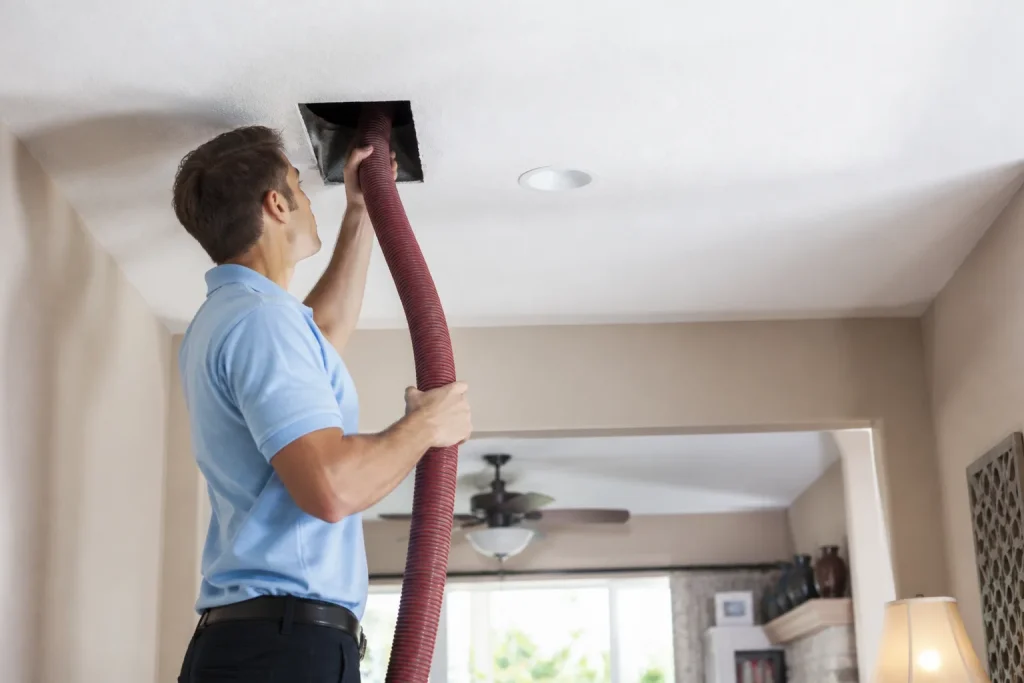
A qualified same-day duct crew brings negative-pressure containment, HEPA-rated vacuum equipment, and a written scope. It does not bring a shop vac and a promise. The equipment matters more than the arrival time.
At a professional level, the process looks like this:
- Negative pressure containment is set up so the work area stays under a slight vacuum relative to the rest of the house. Air flows into the work zone, not out of it, which is what keeps displaced debris from drifting into the living space.
- HEPA-rated vacuum equipment captures fine particulates at the source instead of blowing them past a standard filter. We use Nikro HEPA-rated systems for exactly this reason, and we run Abatement Technologies air filtration in the work area to keep the ambient air clean while the job is in progress.
- Rotary brush agitation loosens compacted debris from duct walls before it’s pulled into the vacuum. We use Rotobrush rotary-brush systems for this, which is the professional standard for dislodging stuck-on contamination rather than just skimming the surface.
- Source-side repair so the cleaned system isn’t immediately re-contaminated. A cleaned duct with an open breach is a duct that needs cleaning again next season, which is why we treat duct repair and sealing as part of the job, not an upsell.
- Optional sanitizing where microbial growth has been confirmed, using a product labeled for HVAC interiors.
In an occupied home, the containment step is the one that matters most. Ask whoever you hire how they plan to keep displaced air out of your kitchen, and be skeptical of anyone who shrugs at the question.
Taylorsville Winter Context: Why Contaminants Spread Fast Here
Taylorsville winters mean the HVAC runs continuously for weeks at a stretch, which gives any contamination inside the system a long, uninterrupted window to distribute through the whole house before anyone notices. That’s a different problem than a system that cycles on and off through a mild fall.
What that means in practice: a small breach in a return, a crack in a flex run, or a rodent entry point that opened up in cold weather can distribute debris into every room fed by that branch long before the smell or the visible dust gives it away. The furnace runs, the blower moves the air, and the distribution has already happened by the time someone notices a musty smell in the hallway.
That’s also why our winter emergency calls so often land on “system-wide” rather than “one room.” By the time a homeowner calls, the contamination has usually traveled. A proper inspection and a whole-system cleaning, not a single-branch spot clean, is what actually gets the house back to normal. And once the ducts are clean, an Aprilaire or Honeywell filtration component added to the system gives you a measurable, ongoing defense against the next round, which is the difference between cleaning and managing.
If you’re already there, the sooner you shut the system down and call, the smaller the cleanup. Call (833) 468-5997 for a free estimate. We answer 24/7. Fast dispatch from 7am to 7pm, Sunday through Friday.
When to Call a Pro (and When to Call a Different Pro First)
If the contamination is inside the duct system, call a duct cleaning specialist who can inspect, clean, repair, and seal. If the HVAC unit itself is compromised, call an HVAC technician first and have the duct work assessed once the unit is safe to run.
Our technicians have up to 12 years of experience, and the split is usually obvious once someone looks. Smoke, rodent waste, or visible mold in the ducts is a duct service. A burning smell, a blower that won’t run, or water inside the air handler is an HVAC service, and pulling a cleaning crew in before that’s addressed just reintroduces the problem. If a homeowner isn’t sure which one they’re dealing with, calling and describing what they see is the fastest way to sort it out.
Related Services in Taylorsville
If the emergency turns out to be a cleaning and repair situation, we handle air duct cleaning, dryer vent cleaning (worth a look if you smell something hot and linty coming from the laundry room), and integrated duct repair and sealing. All of it runs through Taylorsville Air Duct Cleaning Pros.
What happens when you call
- 1
A real person answersNo phone trees – you reach a local pro.
- 2
You get an upfront price rangeHonest numbers before anyone is dispatched.
- 3
A background-checked tech heads outLicensed & insured, dispatched right away.
- 4
You approve before work beginsNothing starts until you say go.
The Bottom Line
If you found contamination in your ductwork, the sequence is: stop the system, block the affected vents, document what you see, get a proper inspection, and then clean. Cleaning before containment is how a single-room problem becomes a whole-house one. The homeowners who come through an emergency with the least mess are the ones who slowed down for the first ten minutes.
If you’re in Taylorsville and need help, Taylorsville Air Duct Cleaning Pros offers free estimates. Call (833) 468-5997. We answer 24/7. Fast dispatch from 7am to 7pm, Sunday through Friday. Our technicians are licensed and insured as their state requires, the price is set by the written estimate before work begins, and you get before-and-after photos of your own ducts so you can see exactly what was there.
Frequently Asked Questions
No, and a shop vac makes it worse, not better. A consumer vacuum pulls loose dust toward the filter but it doesn’t create negative pressure inside the duct system, so the blower and the vacuum end up fighting, and the loose contamination wins. Loose debris gets pushed through the system while you’re working. The correct first move is shutting the thermostat off and calling someone with proper containment equipment. Call (833) 468-5997. We answer 24/7. Fast dispatch from 7am to 7pm, Sunday through Friday.
Usually not, provided the crew sets up negative-pressure containment and filtration in the work area before they start. That containment is what keeps displaced air out of the rest of the house, so you can stay put in most cases. If the contamination is heavy smoke residue or active rodent waste, the technician may recommend keeping pets and young children out of the affected rooms until the work is finished. Ask them to explain the containment plan before they open anything up. Call (833) 468-5997 for a free estimate.
It depends on the size of the system, the type of contamination, and whether repair or sealing is needed, so the honest answer is that the price is set by a written estimate after inspection. What you should insist on is one flat price per system, agreed before work starts, with no per-vent pricing and no low teaser that turns into a bigger invoice once the technician is on site. That’s the bait-and-switch pattern this industry is known for. Call (833) 468-5997 for a free estimate and ask for the scope in writing.
An emergency involves an active contamination source (smoke, rodents, confirmed mold), a safety concern, or contamination that is still spreading through the system. A routine job is dust, allergen, or airflow buildup with no active source. If you’re not sure which one you’re looking at, turn the system off, block the affected vents, and call (833) 468-5997. We answer 24/7, and fast dispatch runs from 7am to 7pm, Sunday through Friday. The inspection is the fastest way to know.
Written by the team at Taylorsville Air Duct Cleaning Pros.
Need Air Duct Cleaning Help?
Call Taylorsville Air Duct Cleaning Pros - the local pro we connect you with is licensed and insured, with free written estimates in Taylorsville.
(833) 468-5997